Monday, November 12, 2012

GUEST CONTRIBUTOR: ARTIST ALETTE SIMMONS-JIMENEZ


     I met Alette when she invited me to show some of my art at her gallery in Miami during Art Basel week quite a few years ago. One of my pieces was a signboard that read:

MY GOD
IS
BETTER
THAN
YOUR GOD

    Alette placed this signboard outside the front door to her gallery, but because of numerous complaints she had to remove it and keep it inside for the duration of the show. So much for “artistic freedom”.
     One of my pieces sold, but at a discount - - - so what else is new, but we did a landslide business in selling my first book, “ How To Become A Famous Artist” which was a spoof on parts of the Contemporary Art World. It was eagerly purchased by artists in the area as a “How To” book and is now a collector’s item (but I have a few left if you want to buy one.)
     During Art Basel week I got to meet a chef who was opening up a restaurant a few doors from Alette’s studio. His name was Michael Schwartz. He went on to become a famous and celebrated chef and I slid further into obscurity.
     But, back to our featured guest, Alette Simmons-Jimenez. Here’s a little background.
     Alette was born in Madison, Wisconsin; she received a BFA from Newcomb Memorial College of Tulane University in New Orleans.  Upon graduation she began her professional career in the Dominican Republic where she resided and worked for 18 years.
 The artist attributes her varied interests to her nomadic military family upbringing.   In every foreign city, survival tactics used as a child made her comfortable with constant change and an astute observer of nuances in social behavior.  Her work focuses on states of belonging and captivity and addresses the significance of human existence with undertones of absurdity that play along as humanity attempts to balance negotiations with nature.


     She has won several fellowships and grants for her work including 1st Prize in Video, at The XVIII National Biennial, Museo De Arte Moderno. She has been represented internationally by private galleries and has exhibited in museums, universities, art fairs, and media festivals and is currently preparing work for her solo exhibit to open fall of 2013 at the Center Gallery of Miami-Dade College.   
   Articles including her work have appeared in numerous magazines and newspapers. Recently the artist was selected as a Miami New Times "100 Creatives", and she was included in the book "Miami Contemporary Artists", and was twice selected for "New American Paintings", once featured on the cover.
   Simmons-Jimenez is also the founder of Artformz, an artist run project dedicated to artistic collaborations.
     I’ve selected a few of her works to include in this piece.   


"
"Walk-In #5 Sound Garden" an audience participatory installation.  Guests can enter the "faux" garden placed in the middle of a highly active public space. Unobserved from the outside, in a moment of peace and tranquility, sitting on garden chairs listening to an audio component via headphones they watch the ongoing activities of others through the semi transparent structure. 

DETAIL of above:  "Fiddle-Dee-Dee"  a birdbath filled with a metaphor.  The spiraling rat race scurries to run up a ladder to nowhere. Placed in the middle of Walk-In #5

'Walk-In #88, Suspended Spiral" an audience participatory installation.  Polystyrene Cords, turned aluminum, blue filtered lights.  The work is a spacial experience - guests are invited to walk into the center of the spiral.


"Falling Suspensions"  Sneak peek to and upcoming solo exhibit in fall of 2013 at Miami-Dade College - digital sketch of in progress installation of suspended woven wire forms - some illuminated. 
 "Nest, 1" another of the nest series - (old school paintingmixed media, pressed flowers, duct tape, on canvas with grommets - 69” x 75”
"Nest 2" one of my latest regular old paintings - mixed media, pressed flowers, on canvas with grommets - 69” x 76”

       And here's a short video. Just click and start up:
https://vimeo.com/53275360


I suggest you go to her website to enjoy the rest of her work.
  http://www.alettesimmonsjimenez.com/works.html 

Friday, November 9, 2012

DON'T CRY FOR JOSEPH A. BANKS

     Anyone who watches TV is familiar with the ads of Joseph A. Banks, the men's clothier, who seemingly offers you the shirt off his back when his advertisements proclaim:
                   "BUY ONE, GET THREE FREE!"
    How can he do it and stay in business? Well you needn't worry about poor Joseph  because I checked out his company's financial statements and believe or not he makes an unbelievable gross profit on sales of 60%. That means for a suit they sell for say $800, they make a gross profit of $480 - - - even after throwing in the kitchen sink.
     It reminds me of the days when I saw a man go into the fitting room at Sym's and put one suit on atop another and then walk blithely out of the store. Maybe he worked for Banks and that's how they get their clothes so cheaply, and why Syms went out of business.
      I feel sorry for the poor soul who goes into his stores on the days when they are not having a sale.

A NEW HOME FOR SISCO BOB


On October 19th, in one of my first posts titled “BACK TO 9 TO 5”, I wrote that I had started to sell on EBay various items I had left over from my studio. The first sale I made was of an Indian mannequin that was part of an installation that told about an Indian maiden, Pokerhontas, and how she was involved in the origin of Las Vegas as a gambling mecca. Here’s a photo of my installation.

HE'S THE ONE ON THE LEFT
POKERHONTAS  IS 3rd. FROM LEFT
The buyer was Mimi Sidwell of the JX RANCH in Tucumcari, NM. I asked her to send me a photo of “Sisco Bob” (her new name for the mannequin) in his new home. I’m afraid she’s a better rancher than photographer  - - - this is the photo she sent, but he looks happy enough.
I wanted to learn more about her ranch so I turned to Google and was fascinated by the story of her life. I learned that Mimi was born in Sweden, grew up horseback riding every day, while dreaming of being a ‘cowboy’ and riding the wide-open spaces of the West.  While living and working abroad she had the opportunity to go on weeklong camp-out rides in Arizona's Monument Valley and Canyon de Chelly.  Right then she knew where her heart had belonged all along.  It was just a matter of time.  In 1988 the opportunity presented itself to move to the U.S.  It was not long before she found herself living on a ranch and learning everything from having hands on experiences fixing windmills, fences and pipelines, to caring for and working cattle, while also helping out day-working on other ranches.  


She met Tom Sidwell in 1995, and in 1996 Mimi sold her farm in her homeland Sweden and purchased a 14,000-acre ranch in South Eastern New Mexico.  Tom was still managing a 64,000-acre ranch an hour and a half away, so Mimi was alone on the new ranch for that first year.  She took care of the 350 cows and calves, and bulls she and Tom had bought, moved them, fed them, fixed fences and repaired water pipeline leaks.  Tom would come out on weekends when together they would install new pipelines and water troughs for the cattle. 
       In the fall of '96 they married, on horseback (of course!) 

     The following spring Tom moved to the ranch, and together they operated it until fall of 1998, when they sold it because of the then uncertainty of the future of public land grazing permits, and bought a ranch in the Pine Ridge area in the Panhandle of Nebraska.
     They've been back in their beloved New Mexico since the spring of 2004 and together operate the JX Ranch, a 7,000-acres working cattle ranch and guest ranch, not a "dude ranch", located in northeastern New Mexico at an altitude ranging from 4,000 to 5,000 feet.
     JX Ranch is owned and operated by the two of them. They have no hired wranglers, cook or other staff.  About 160 Texas Longhorn cows and their Charolais-cross calves graze on this ranch. Every morning they ride out to check on the cattle, watch for new calves being born, or move them to new pastures when scheduled. 
 The calves never receive any antibiotics, hormones or insecticides, and are eventually sold as dry-aged, natural free-range beef to customers throughout the United States.  During the summer months they take up to five guests at a time. (It sounds like the vacation of a lifetime). 
I recommend you visit their website for a very interesting read about their ranch life and to purchase their steaks at: www.leannaturalbeef.com

MIMI AND TOM RIDE OFF INTO THE SUNSET TOGETHER


Wednesday, November 7, 2012

A WHALE OF A TALE


      I would imagine that almost the last subject in the world you’d expect to be reading about in Earl’s Pearls is “whaling”. And at first blush your eyes might glaze over at the thought of reading about life onboard a whaler leaving from Nantucket in the mid 1800’s. And I’m no Herman Melville, but here goes nothing.
      As you may recall from an earlier post, I’ve been disposing of my collection of Victorian era picture albums on EBay. I found, unfortunately, that the price of these albums has plummeted since I bought them a dozen years or so ago and most of my albums are quite ordinary. But, while going through the last box of albums I came across a real winner, perhaps financially, but most surely in that it illuminated the life of the whaling community on Nantucket in the nineteenth century.
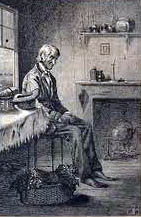
       This album contains pictures of several well-known ships’ captains and their families, and in particular, Captain Nathan Manter. This name  means nothing to you and me, but the Captain was the subject of a wonderful and well-known painting by Eastman Johnson in 1873.                                                


And here’s the Captain’s photo in my album with part of his family.


     The photo album also contained an image of Abraham Quady, the last Indian on Nantucket who was described in a journal of that period as a, “…venerable, inoffensive old man living of his own and supporting himself by selling berries picked on the common. After years of working on whaling ships he became, “…the prince of Nantucket caterers and without his assistance no evening entertainment was complete.” (I wonder how he made the transition from berry picker to caterer. I’m surprised he didn’t open a gambling casino instead.) He died in 1854 at the age of 82.

      I became hooked on the subject of whaling and on the lives of the folks in the album. If you’d rather just look at the pictures, I’ll forgive you, but otherwise here’s a description of whaling that I found fascinating (and it took my mind off the presidential election that comes to a close today.)
    
   Whaling was an exceptionally dangerous business both physically and economically. In the Yankee whale fishery vessels injuries and death were common to almost every voyage. Many vessels were lost. A few individuals got rich whaling and most of those were owners, agents and those captains that lived.  The crew shared in the profits but the spoils were skewed in favor of the top 1%.
     The oil gathered from the blubber was in demand chiefly for lamps. (It was also the mainstay of women’s’ corsets.)


     By the 18th century, whaling in Nantucket had become a deep-sea industry, with voyages extending for years at a time and with vessels traveling as far as South Pacific waters
    Life for the crew aboard a ship was one of cramped living quarters, long periods away from home, bleak meals and hard dangerous and backbreaking work. Long days were often spent just watching, waiting and preparing the equipment for the hunt. The monotony ended once the spotter called out, "thar she blows", when a whale was located. Quickly the hunt was on.
   The prey would spout as many as forty times before “sounding” (disappearing below the surface) and once it sounded it would disappear for as long as an hour, diving to the bottom of the ocean in search of squid and krill.
      Once the ship was in range, the crews dropped the small whaleboats into the water to take up the chase. It was not simply a matter of rowing fast, reaching the whale, and making a kill. Whales have acute hearing, so it was important to approach quietly. The splash of an oar could "gally" (scare) the beast and make it "sound") and swim further away from the boats.
     Once successfully harpooned, the real danger would start. The header would yell "stern all", and the rowers would make it their job to clear the immediate area as quick as possible to avoid the thrashing of the whales' huge tail. When this was accomplished the crews job was to avoid the unwinding rope as the whale tried to escape the hunters. One crew member would continue to douse the rope with water, to prevent the rope from bursting into flames from the friction, as it unraveled. Most whalers who were injured, were hurt during this stage of the hunt. An unraveling rope could easily cut through anything that got in its path and with a rough sea and an unpredictable whale, avoiding the rope and a thrashing whale was not an easy task.
      As the whale dived it would drag the boat at speeds of up to twenty-five miles per hour, in what was called a "Nantucket Sleigh Ride".
      A whale might tow a whale boat for miles before it tired. A whale sometimes smashed or overturned a boat during the chase, and few crewmen knew how to swim.
Once the whale began to rise again to the surface, the crew would take in the slack rope hand over hand until it once again tightened. After the hunt was over the whalers had the task of returning the dead carcass, all forty tons or so, back to the ship. And then the real work began as the behemoth
was cut up and its blubber boiled down to yield its precious oil.
        Whaling, with all its hardships and peculiar customs, was immortalized in the pages of Herman Melville's classic novel Moby Dick. Melville himself had sailed on a whaling ship, the Acushnet, which left New Bedford in January 1841.
       By 1851, overfishing had decimated whale populations in the Atlantic Ocean. Most whalers moved to the Pacific and Indian oceans. Ships traveled north and south with the seasons, following the large whale populations on their annual migrations. (Maybe that’s why some of the photos in my album list families who moved to San Francisco.) The whaling industry flourished in New England from about 1820 to 1860, until the demand for oil for illumination was replaced by oil taken from the ground.
      Commercial whaling in the 1800s was far more racially integrated than most trades on land, and racial prejudice was generally more muted on whale ships than in society at large. Black and white whalers had to work side by side to get the job done—and to survive.
       Many owners of whale ships were Quakers, a religious group opposed to slavery. Some New England towns were also important stops on the Underground Railroad, an informal network that provided safe passage to people trying to escape slavery. And these towns needed seamen, including free black people and those who had escaped slavery.

     And I guess it’s only fitting to end this post with a photo from my album of Oliver Cromwell Coffin III.  I doubt that he was ever within a mile of a whale.


Monday, November 5, 2012

GUEST CONTRIBUTOR - PHOTOGRAPHER LYNN GOLDSMITH


    I met Lynn Goldsmith about a dozen years ago in Florida when she was visiting her aunt and uncle, David and Gloria Leader. I admired her photography and she admired my art, so how could we not become friends.                                     
     Her career as a photographer has zoomed in the interim and her imagery is in numerous collections: The Smithsonian, The Polaroid 
Collection, The Kodak Collection, The Museum of Modern Art, The Chicago Museum of 
Contemporary Photography, and the Museum Folkwang.
     Lynn's portrait photographs have appeared on and between the covers of just about every major magazine. 
Her subjects have varied from entertainment personalities to sports stars, from film directors to 
authors, from the extra-ordinary to the ordinary man on the street. Her forty years of photography
 have not only been an investigation into the nature of the human spirit, but also into the 
natural wonders of our planet.
     While Lynn is best known for her photographs of luminaries of the music world I’ve also included some of her travel photographs for your viewing pleasure. 


     You can see more at her website: lynngoldsmith.com. 
    (If you buy one of her wonderful books I might even get a commission.)

Friday, November 2, 2012

POLITICS AS USUAL


     I promised myself I would steer clear of Politics on my Blog, but like a good politician I’m a flip-flopper. I’ve never known a time when there is such acrimony in an election campaign not only in TV ads but also between friends and neighbors. What made me change my mind about avoiding Politics was an Op Ed piece by David Brooks in the New York Times a week before the election.
    The article made a case for voting for Governor Romney based on Brook’s hypothesis that if Obama were reelected the Republicans in Congress would not work with him in any manner or form on any important legislation; but if Romney were elected he would move towards the center and enough Democrats would vote with him to “get the big stuff done.”
     Brooks goes on to blame Obama for, “running such a negative presidential campaign”, and the impact this would have on getting Republicans to work with him. Nowhere in the article does Brooks blame the Republicans for running a negative campaign. Maybe David's TV is broke or maybe he just believes the Democrats are thicker skinned. He certainly wouldn’t want anyone to believe the Democrats are more concerned with the future of the country and therefore more willing to compromise than the conservatives in the other party.
      Brooks calls Romney, “more of a flexible flip-flopper than Obama” - - - so vote for him.

    Maybe he’s right, but it sure seems strange to vote for someone for president because he’s a better “flipper” and because his party members (mostly in the House) are less willing than Democrats to compromise for the good of the country.
     But maybe he’s wrong. Here’s another possible scenario that Brooks didn’t consider. Just maybe Obama learned from all the criticism of his first term unwillingness to “fight” for Simpson/Bowles and other legislation just as he learned to “fight” after his lackluster showing in the first debate. If he’s elected maybe he’ll got off his ass White Horse and take to the bully pulpit to produce a groundswell from the countryside that would teach the recalcitrants in both parties that “compromise” is not a dirty word.
     And now a few more words of criticism of President Obama with regards to his campaign to increase taxes on the very rich. He’s turned the issue into one of class warfare while what he really should have been saying is that the story of Horatio Alger - - - rags to riches - - - is his and the country’s American Dream. He made the word “millionaire’ into a dirty word instead of the respected goal of any hard-working individual who wants to earn a lot of money.
   Yes I’m a Democrat, (a disillusioned Obamacrat) 
and I’d vote for a Republican running against Obama if that party had put up a candidate who was the “more center-right candidate” that Brooks thinks will evolve from Romney the flip-flopper (Brooks’ words.)
     The absurdity, to me, of it all is that Romney has convinced the poor guy who works 8-10 hours a day that the tax loopholes that make what Romney (and others who run hedge funds and alike) and who work the same 8-10 hours a day as Joe, pay federal income taxes of only 15% while Joe the Plumber pays more than twice as much, and seemingly couldn't care less.
     
     Obama, by his attack on the rich, instead of on the tax system, has helped push Joe the Plumber further into the Republican camp. 
    And to get this last thing off my chest, all those who complain that our corporate tax rate is too high look at the tax returns of most of American’s largest companies - - - they pay little or no US tax by transferring their profits to the books of their foreign subsidiaries. Even GE pays less taxes, percentage wise, than Joe the Plumber and even Earl the Blogger.

WHAT'S IN A NAME PART 2

    Those of you who read my post of October, 18, 2012 (WHAT'S IN A NAME)  know that I was born with the surname of Bronstein. I'm always interested to read about people with that last name, wondering if they are long lost cousins from Minsk in Russia. One who certainly  isn't is ANNABELLE BRONSTEIN, whose named was featured on an episode of SEX IN THE CITY. It's funny and you can view at this link:http://www.youtube.com/watch?v=NC2LRd0mm18